VINAMERICAS | NEWS
How Winemakers Choose Their Oak: Tradition Meets Innovation in Two Spanish Cellars
September, 3rd 2025
At every great winery, the barrels that line the cellar walls are as critical to the final wine as the grapes themselves. Their wood, their age, even the forest they come from, all play a part in transforming grape juice into a wine that tells a story. Nowhere is this more evident than in Spain, where tradition and terroir collide at houses like Bodegas Urbina in Rioja and Legado de Orniz in Toro. Here’s how their winemakers, Angel Urbina and Diego Ribbert, approach the delicate art of oak selection—a quiet but vital act that defines their signature wines.
In Rioja, Tradition and Harmony
For Angel Urbina, the fourth generation at Bodegas Urbina, harmony is key. The classic Rioja style conjured in his family’s cellars relies on a carefully tuned “melody” of oak. “Each barrel has distinct notes which we harmonize to compose a melody in line with the style of wine we make,” says Urbina. American oak, gently seasoned and seldom new, forms the backbone of Urbina’s Gran Reservas and Reservas, lending trademark vanilla and spice.
But it doesn’t end there. Urbina blends in a discreet whisper of new French and American oak, adding complexity—yet never allowing oak to overpower. Over time, as barrels age, the gap narrows: “Over the years, the barrels of American and French oak become more similar,” he observes, hinting at how repetition and patience coax the most harmonious result.
In Toro, Precision and Expression.
Meanwhile, in the rugged, ancient landscape of Toro, Legado de Orniz pulses with the energy of the Tinta de Toro grape. Here, Diego Ribbert, an Argentinian transplant with a European soul, eschews American oak altogether. “We use only French oak barrels, regular size (225 liters each), because the evolution and aging of our Tinta de Toro in that type of oak is perfect,” Ribbert explains. For Legado de Orniz, French oak is a partner, not a mask—its tight grain preserves the grape’s wild fruit and muscular tannins, keeping the wine both elegant and true to its origins.
The Toast that Makes the Taste
Oak isn’t just about geography; it’s about craft. Urbina harnesses both lightly and heavily toasted barrels, knowing that the more intense the heat, the more the staves yield roasted, cocoa, and coffee notes. “These flavors fade and become more homogeneous over the years,” he says, underscoring how well-managed cellaring is key to the classic Rioja profile.
Legado de Orniz winemaker Diego Ribbert in his analysis lab.
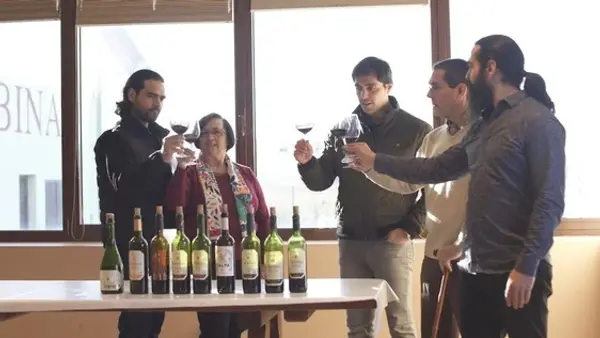
The Urbina family, winemaker Angel Urbina far right.
Learn more about Legado de Orniz and Urbina